
The Wrong Question
The debate consuming the marketing profession right now is framed as a binary: will AI replace marketers? It is the wrong question, and the fact that it dominates the conversation tells you something about how poorly the industry is thinking through what is actually happening.
The question conflates two distinct phenomena. Displacement is when a specific role becomes structurally unnecessary — the tasks that defined it are now performed more cheaply, faster, and reliably by an automated system. Transformation is when a role changes so fundamentally that the title persists but the work is unrecognisable. Both are happening simultaneously, at different rates, in different parts of the profession. Asking “will AI replace marketers?” is like asking in 1995 whether the internet would replace commerce. The answer is neither yes nor no. It is: it depends which part of commerce you mean, and what you do about it.
The right question is: which specific roles, composed of which specific tasks, are structurally at risk — and what causal conditions determine whether those losses are net negative or net neutral for the profession over a decade?
This piece attempts to answer that with data rather than conjecture.
The marketing profession employs roughly 2.75 million people in the United States across four distinct groups: Communications and PR, Creative Agencies, Media Agencies, and In-House Marketing Departments. Our bottoms-up analysis — built role by role, task by task, tool by tool — identifies between 1.25 and 1.64 million of those roles as structurally at risk over the next five to seven years.
It’s also not the whole story.
The Method: Why Most Forecasts Are Useless
Before I start, I want to overview how I did this. Personally I hate most of the crappy McKinsey pieces of analysis that simply multiply a statement about percentages onto a total workforce. Lazy, simplistic thinking.
Most AI employment forecasts are built top-down. They take a percentage — Goldman Sachs’ 18% of global work, Anthropic’s finding that 64.8% of marketing specialist tasks are AI-exposed — and multiply it by a workforce number. The result is a large, alarming figure that is simultaneously unfalsifiable and unactionable. It doesn’t tell you which roles, which tasks, which timeline, or which tools.
The major problem with this approach is that it conflates task exposure with role displacement. A role is a bundle of tasks. A Social Media Coordinator doesn’t do one thing — they write captions, schedule posts, respond to comments, analyse performance, brief designers, and produce monthly reports. The question is not whether AI can do any of those tasks. The question is whether AI can do enough of them well enough that the economic case for hiring a human to do the rest collapses.
My method works differently. For each role: identify the US employment figure using BLS data or verified industry surveys. Map the core tasks that comprise the role. Test whether a specific, currently available AI tool performs those tasks at commercial quality. Cross-reference against real-world evidence — companies that have already made cuts, job posting data showing declines, industry surveys tracking hiring intent. I think this provides a better anchor for this overall.
The anchor for this analysis is the Anthropic 2026 Labour Market Impacts study — notable not because Anthropic built the AI systems in question, but because their methodology is the most rigorous available. They measure observed exposure: what Claude is already doing for people in these roles in practice, not what AI theoretically could do. Marketing specialists ranked fifth of 800 occupations studied. Two thirds of what a marketing specialist does is already being done, at least in part, by AI in the real world. That is the baseline.
The Bear Case: Four Groups, Fifty Roles, One Pattern
The bear case is not that AI will eventually be capable of replacing these roles. The bear case is that it already is — and that companies are already acting on that fact. Looking at roles specifically you can see dozens of leading indicators combined with real world examples of agentic AI replacing jobs fast.
Communications & PR
The communications profession is built on a craft that AI has now largely commoditised at the production layer: taking information and converting it into structured written output. Press releases, media briefs, coverage reports, internal communications, talking points — all of these follow templates, require factual assembly, and reward speed and volume over originality. That description also perfectly characterises what large language models do best.
The Press Release Writer — roughly 135,400 people under BLS SOC 27-3043 — faces the starkest near-term pressure. The Associated Press already auto-generates thousands of earnings stories per quarter. Prowly generates complete AP-style releases from a brief in under a minute. The craft involved at the junior level is largely template-matching and factual assembly, not editorial invention.
The Media Monitoring Specialist — an estimated 10,000–17,000 roles based on job board data — is structurally eliminated. Cision, Meltwater, and Brandwatch monitor more than 50,000 sources simultaneously, assign sentiment scores at 90%+ accuracy, and flag crises faster than any human analyst. This isn’t a role in transition. It is a role in its final years.
The PR Reporting Analyst — an estimated 8,000–12,000 roles — faces the same verdict. Muck Rack’s automated dashboards generate coverage reports, AVE calculations, share-of-voice analyses, and sentiment trend lines that previously consumed 40 hours of analyst time per month. The function compresses to two hours of review.
The PR and Communications Coordinator — estimated 40,000–60,000 roles — faces the subtler but equally significant pressure of workflow automation. Muck Rack’s PressPal.ai builds targeted journalist lists from press release content. Prowly auto-sequences follow-up pitches, tracks opens, and triggers personalised outreach. The four-to-six hours a coordinator previously spent on daily outreach management is replaced by a 30-minute review of AI-executed actions.
The leading indicator is already visible in job posting data, which has declined materially across PR roles as hiring freezes compound at the entry and coordinator layers.
Creative Agencies
Creative agencies have a commercial secret they have never advertised: the majority of their headcount is not doing original creative work. It is adapting, producing, trafficking, resizing, translating, proofreading, and coordinating. The genuine creative insight layer — the work that actually creates commercial value — is a fraction of total staff. AI has now automated the majority layer, and the industry data confirms it is already happening.
The most important number in this entire analysis comes from the UK’s IPA Agency Census 2025: creative agency employment fell 14.3% year-on-year. Workers aged 25 and under fell 19.2%. Graduate trainee programmes collapsed from 56% of agencies running them to 43.4%. The industry has structurally stopped replacing its own entry-level. That’s a fucking big number.
The Junior Copywriter — approximately 45,860 roles under BLS SOC 27-3043 — is the most documented casualty. Entry-level copy roles have declined sharply as Claude, GPT-4, and Jasper AI generate product descriptions, promotional copy, email campaigns, and social captions in 15 to 30 seconds. One AI instance replaces the output of two to three junior copywriters doing routine promotional work. The Blood in the Machine documentation of copywriters being “forced to use AI until the day I was laid off” is no longer anecdote.
The Production Designer — part of a 265,900-strong graphic design workforce (BLS SOC 27-1024) — faces near-total automation of the production function. Canva Magic Design and Adobe Firefly generate hundreds of asset variants, social templates, and format resizes simultaneously. A designer who previously spent 70% of their time resizing and adapting assets now uses that time for creative direction while AI executes the production. Goldman Sachs estimates 26% of all design tasks are automatable. In production design specifically, the figure is closer to 70%.
The Storyboard Artist — estimated 8,000–12,000 roles — has seen Publicis and other holding companies adopt AI storyboarding tools (Adobe Firefly, LTX Studio, Boords AI) that convert scripts to full storyboards with character and lighting consistency in 30 minutes versus the two to three days a human artist required. Production time for this function has been cut in half across agencies deploying these tools.
The Translation and Localisation Specialist — 58,870 people in the BLS Interpreters and Translators category (SOC 27-3091) — faces the fastest-moving displacement curve. ElevenLabs voice cloning and DeepL localise advertising campaigns across 29-plus languages including audio adaptation, reducing cost by 70 to 90%. Mondelēz generated over 1,800 localised celebrity ads for the Indian market via voice cloning without a single reshoot. The role doesn’t disappear — it becomes a quality auditor of AI-generated localisation rather than a practitioner. I seriously doubt these roles survive except as very niche specialists.
Forrester’s projection, notably upgraded from its original estimate, now puts US creative agency job losses at 15% by end of 2026 — having raised that figure from 7.5% by 2030. The revision direction matters as much as the number.
Media Agencies
Media agencies are the furthest along this curve, and the reason is straightforward: the core execution function — buying media — already runs algorithmically. The vast majority of US digital display advertising is purchased programmatically. Manual CPM bidding was deprecated by Google’s DV360 in May 2025. The automation of media buying is not a forecast. It is history.
Sir Martin Sorrell put it plainly: “There won’t be 250,000 people in media planning and buying in two or three years’ time.” He compared it to the algorithmic replacement of portfolio managers in investment banking — not a gradual transition but a wholesale structural shift.
The Programmatic Trader — a role that barely existed 15 years ago and grew to thousands of positions as digital buying scaled — is now being automated by the same technology that created it. RTB engines evaluate 40-plus signals per impression in under 100 milliseconds. The Trade Desk’s Kokai, DV360’s machine learning bidding, and StackAdapt AI handle every auction decision that traders previously monitored manually. The manual optimisation controls that defined the role have been systematically removed from the platform.
The Campaign Manager in Paid Search faces the same trajectory. The State of PPC Report 2026 documents explicitly how Google AI Max campaigns require only goal-setting and asset upload, with the platform self-optimising across all variables in real time. Advertisers consistently report AI has removed the manual optimisation controls their campaign managers relied upon. Amazon DSP Performance+ reduced campaign setup time by 75% and improved acquisition costs 51% versus manual management. The campaign manager’s daily workload — monitoring, adjusting bids, reallocating budgets, writing optimisation notes — has been automated by the likes of PMAX and Advantage+.
The Reporting Analyst — a subset of the 941,700-strong Market Research Analyst category (BLS SOC 13-1161) — has seen their function replaced by platform-native intelligence. DV360, The Trade Desk, and Amazon DSP all generate automated performance dashboards with anomaly flags and optimisation recommendations. The analyst’s three to four hours of daily data pulling, Excel modelling, and narrative writing has been compressed to 30 minutes of reviewing AI-generated output.
The Ad Operations Specialist — estimated 2,000–5,000 roles — is perhaps the clearest example of a function that no longer needs to exist at scale. Meta Advantage+ Shopping grew 70% year-on-year in Q4 2024, generating over $20 billion in annual run-rate revenue, doing so by replacing the manual coordination layer entirely. Creative trafficking, A/B testing setup, and performance monitoring now run with near-zero operator intervention.
The holding company data confirms the direction. WPP cut 7,000 positions. Omnicom cut 3,000 in 2024 and a further 4,000 post-IPG merger. Dentsu cut 3,400, representing 8% of its overseas workforce. Collectively, the “big six” holding companies saw their first headcount decline since the pandemic in 2024 — and the trajectory has not reversed.
In-House Marketing Departments
US employment: ~1.1 million-plus
The in-house marketing function has the broadest absolute exposure in this analysis. The Anthropic finding is worth restating precisely: marketing specialists have 64.8% observed task exposure to AI — ranked fifth of 800 occupations, measured not by theoretical capability but by what Claude is already doing for people in these roles in practice today.
The Email Marketing Coordinator — approximately 79,687 roles based on job board data — faces the most comprehensively documented case for displacement. HubSpot’s AI Email Writer now handles the five tasks that comprised roughly 85% of the coordinator’s working week: subject line generation and testing, body copy drafting in brand voice, CTA optimisation, send-time selection per individual, and list segmentation. An AI system generates 50 subject line and body copy combinations in under two minutes. The coordinator’s function compresses to reviewing AI output and managing exceptions. Klarna deployed OpenAI’s tools across its marketing function and reported $10 million in annual savings — before discovering that quality degraded enough to prompt partial rehiring. Both halves of that story are instructive.
The Social Media Coordinator — approximately 61,443 roles — faces a similar compression. Sprout Social AI generates captions, video subtitles, alt text, and hashtag strategies. It calculates optimal posting times from 16 weeks of audience engagement data per platform. It responds to 60–70% of routine comments automatically. One coordinator managing an AI-augmented Sprout Social account now handles what previously required two people. The role doesn’t disappear — it halves.
The Marketing Coordinator — approximately 457,094 roles according to Zippia data — is the broadest exposure point in the entire analysis. The core function: scheduling, CRM data entry, report generation, routine correspondence, and task management. HubSpot automations, Zapier AI, and Claude collectively handle the 60–70% of the coordinator role that was administrative. The remaining 30–40% — judgment, relationship management, exception handling — still requires a human. But it doesn’t require one full-time.
The SEO Specialist — estimated 50,000–80,000 roles with no discrete BLS category — has perhaps the most visible leading indicator: SEO job postings dropped 37% year-on-year in Q1 2024. Surfer SEO and Jasper integrated create keyword-optimised content with competitive SERP analysis built into the workflow. The four to six hours a specialist previously spent on keyword research, competitor analysis, content briefing, and on-page optimisation now takes 45 minutes with AI tools. Mid-level SEO roles are down 6%; senior roles have grown 3% — the execution layer is being removed while the strategic layer holds.
The Number
Adding this up across all four groups with sourced employment figures:
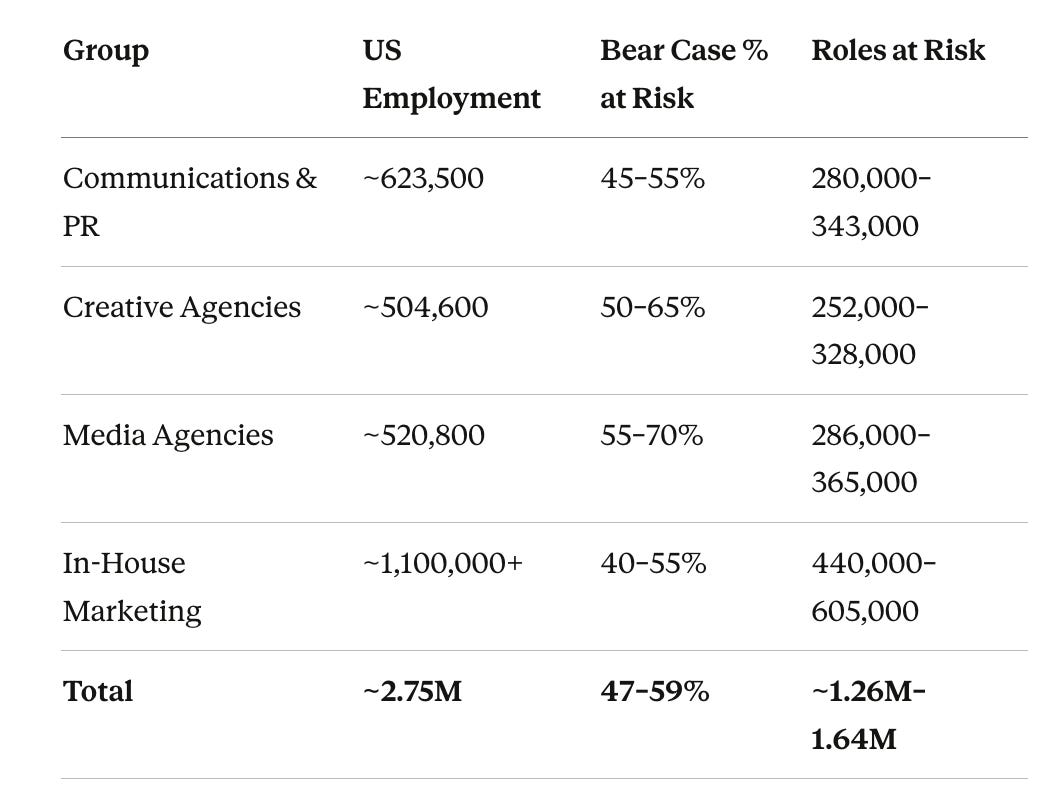
Between 1.25 and 1.64 million US marketing roles are structurally at risk over a five-to-seven year horizon. This is concentrated in junior and mid-level production roles across all four groups. It is not a cliff — it is a long slope that is already underway.
The Bull Case: Four Chains That Must Hold
The bear case is well-evidenced. The bull case is more interesting, because it is not simply the bear case with a positive sign. It is a different causal model entirely — one that requires four specific conditions to hold simultaneously.
Chain A: The Jevons Effect
In 1865, economist William Stanley Jevons observed that more efficient coal engines didn’t reduce total coal consumption — they increased it, because lower cost per unit of energy drove higher total demand. The same logic applies here: when AI reduces the cost of producing marketing output by 80–90%, the rational corporate response is not to bank the saving. It is to produce ten times more marketing.
The evidence that this is already operating: the Content Marketing Institute found that 72% of B2B marketers using AI tools are increasing total content output, not reducing it. When a campaign that took six weeks takes six days, companies don’t run fewer campaigns. They run more campaigns, in more channels, with more audience variants, in more markets. The production constraint was suppressing latent demand. AI releases it.
For this chain to hold, companies need to actually increase total marketing activity rather than reduce costs and shrink teams. The CMO Survey data is currently ambiguous — 36% plan headcount reductions, but marketing budgets grew to 7.7% of revenue in 2024. Both are happening simultaneously. The Jevons effect wins if the demand expansion outruns the efficiency compression.
Chain B: Market Expansion
There are approximately 30 million small businesses in the United States. The vast majority have no meaningful marketing infrastructure — not because they don’t want it, but because the economics didn’t work. A 12-month professional marketing programme previously cost $80,000–$150,000. With AI, the same output costs $8,000–$20,000. Millions of businesses that were previously priced out become viable buyers of marketing services.
This is the supply-side equivalent of what happened to web development when no-code tools emerged. The market didn’t contract — it exploded, because the addressable market was always much larger than the economics allowed. Boutique agencies running lean AI-augmented teams can now service clients they could never have reached. Account directors, brand strategists, and client relationship managers at these agencies don’t disappear — they become more valuable as the book of business each person manages expands.
For this chain to hold, new buyers need to actually enter the market at scale. This is the most empirically testable of the four chains, and the data from boutique agency formation rates in 2025–2026 will be the clearest signal of whether it is operating.
Chain C: The Complexity Ratchet
Every automation layer creates new complexity in the layer above it. Programmatic advertising didn’t eliminate media agency roles — it created a wave of programmatic traders, data analysts, and attribution specialists for a decade, before those roles too began compressing. AI-driven marketing creates the same dynamic: new roles that are genuinely difficult to automate because they require taste, strategic judgment, or relationship capital.
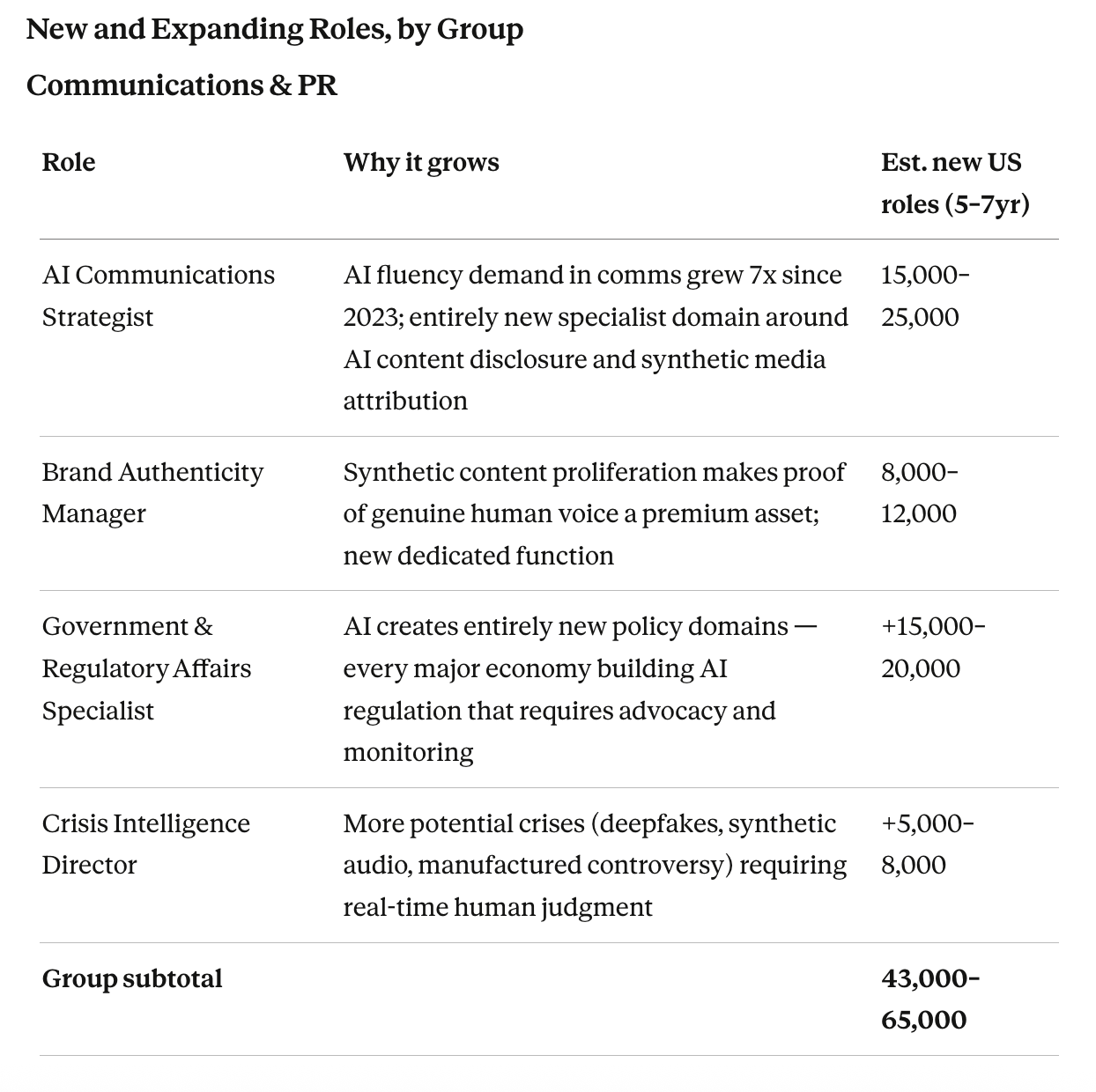
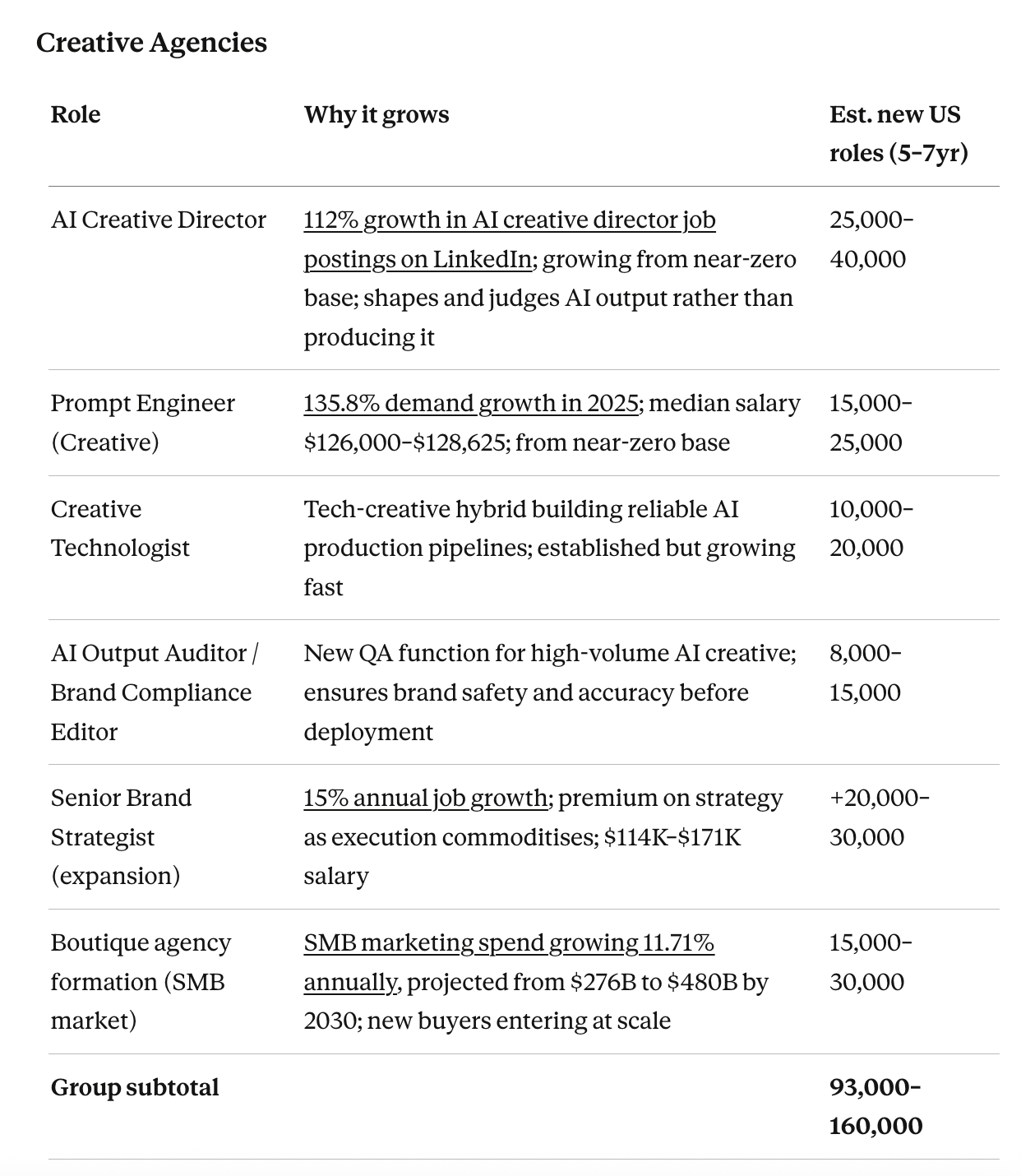
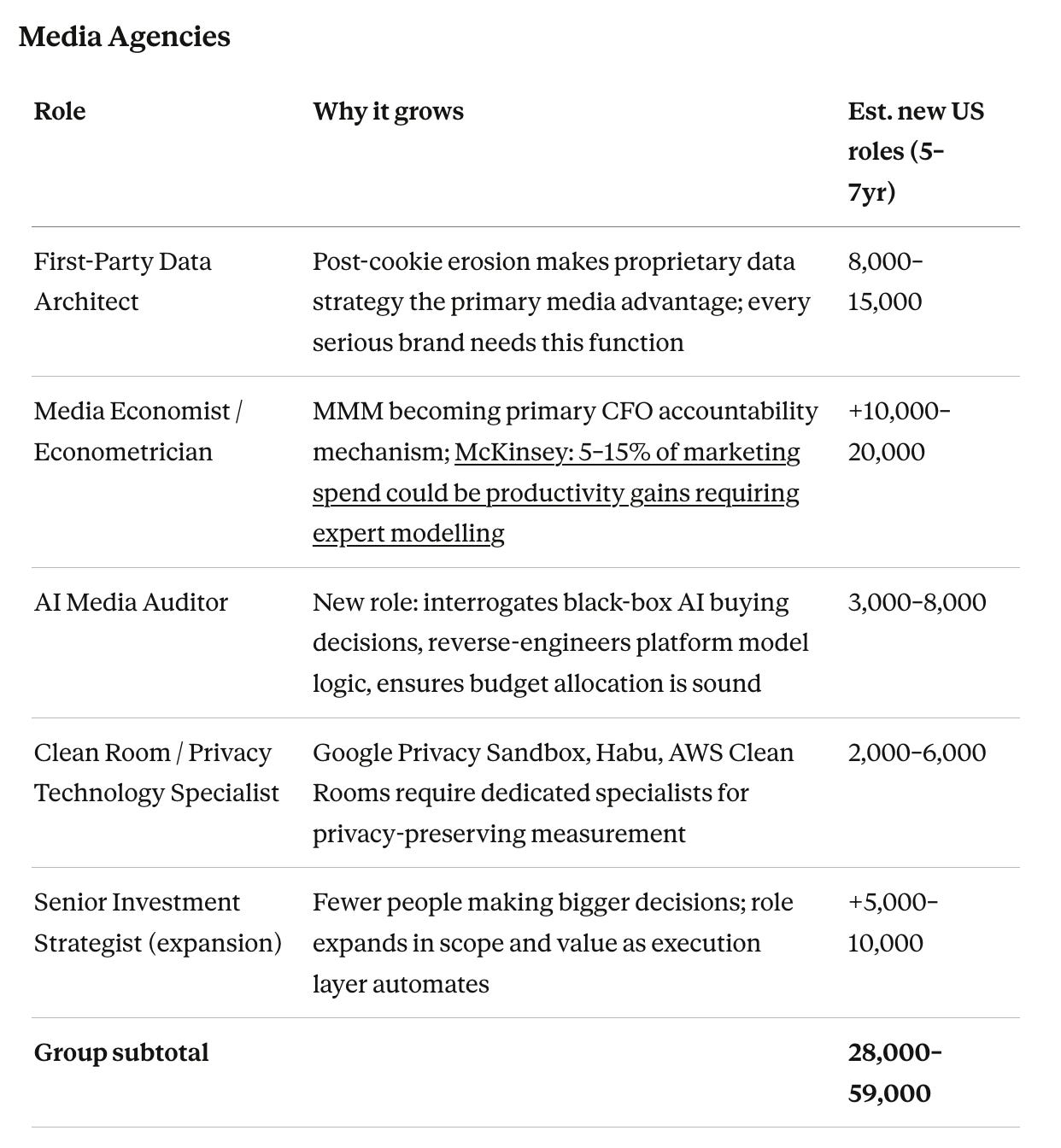
The AI Creative Director — someone who shapes, prompts, judges, and edits AI output rather than producing creative work directly — is a role that does not exist at scale today and will be one of the most in-demand marketing positions by 2028. The Marketing Economist — building causal models that prove which marketing investment actually drives revenue, not correlation — is becoming the primary accountability mechanism as CFOs demand proof of ROI. The First-Party Data Architect — building the proprietary data infrastructure that makes AI campaigns more effective than competitors’ — is a function every serious brand will need as third-party tracking continues to erode.
The 56% wage premium for AI-fluent workers documented by PwC is the market’s current valuation of this skill gap. That premium will widen before it narrows.
For this chain to hold, these new roles need to be accessible to displaced execution-layer workers, not just technologists and data scientists entering the profession laterally. If the new roles are filled by a different talent pool, the marketing profession is being partially colonised rather than self-regenerating.
Chain D: Economic Acceleration
This is the longest-horizon chain and the hardest to verify, but it underlies all the others. If AI delivers the 1–2% annual GDP uplift that Goldman Sachs projects, the total marketing pie grows because the economy grows. More companies, more products, more services, more brands competing for attention. The absolute demand for marketing services expands even if efficiency gains mean each dollar of demand requires fewer people to service it.
The historical precedent is consistent: every major productivity wave in the last century ultimately created more jobs than it destroyed, because the economic growth it generated created new categories of demand that didn’t exist before. The question — and it is a genuine question, not a rhetorical one — is whether this wave moves fast enough that the transition period’s casualties are a temporary price, or whether the pace and scope of AI automation makes this wave structurally different from prior ones. The WEF Future of Jobs Report 2025 projects AI will create 19 million jobs globally while displacing 9 million — net positive, but with severe distributional asymmetry in the transition period.
The Bull Case, Quantified
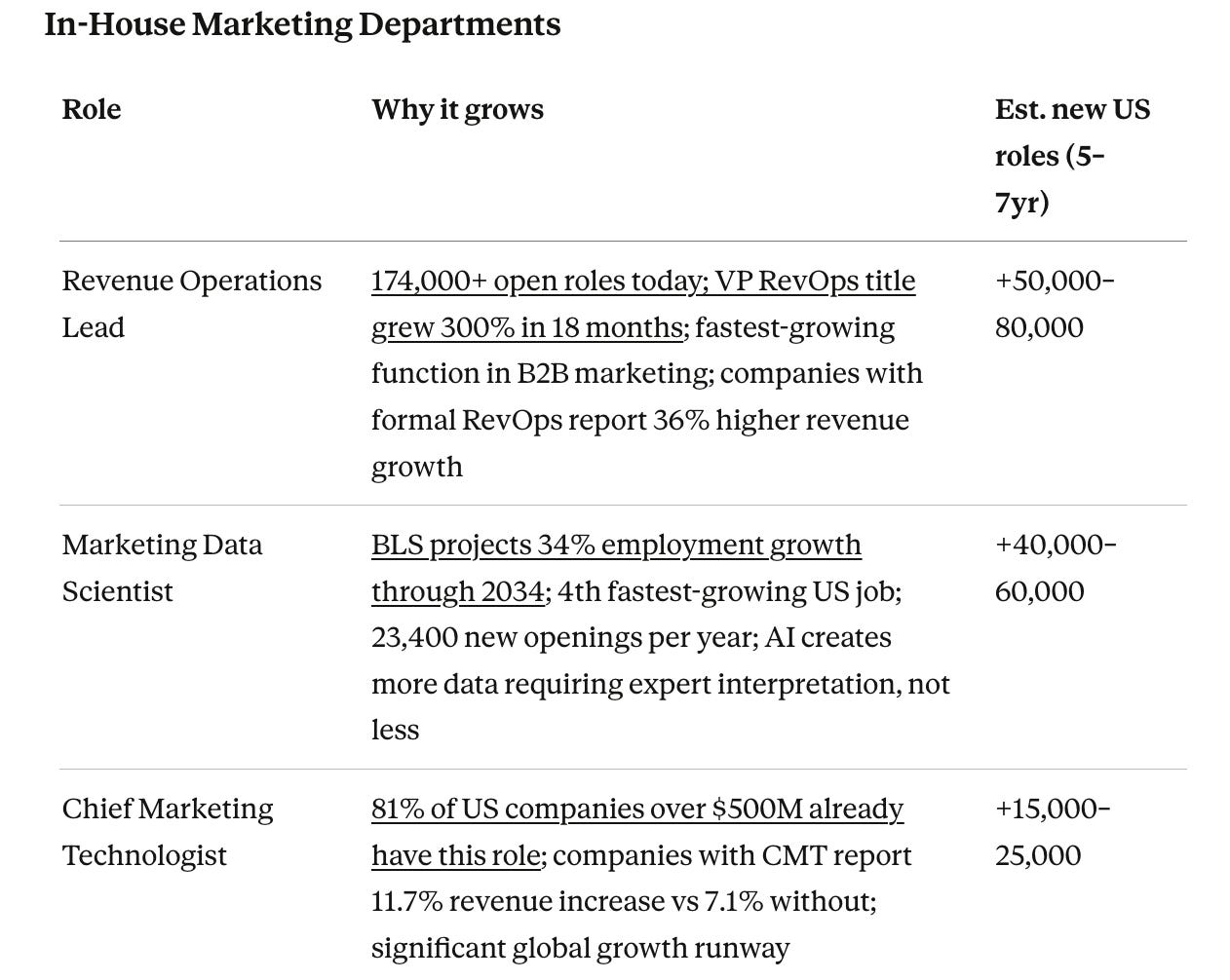
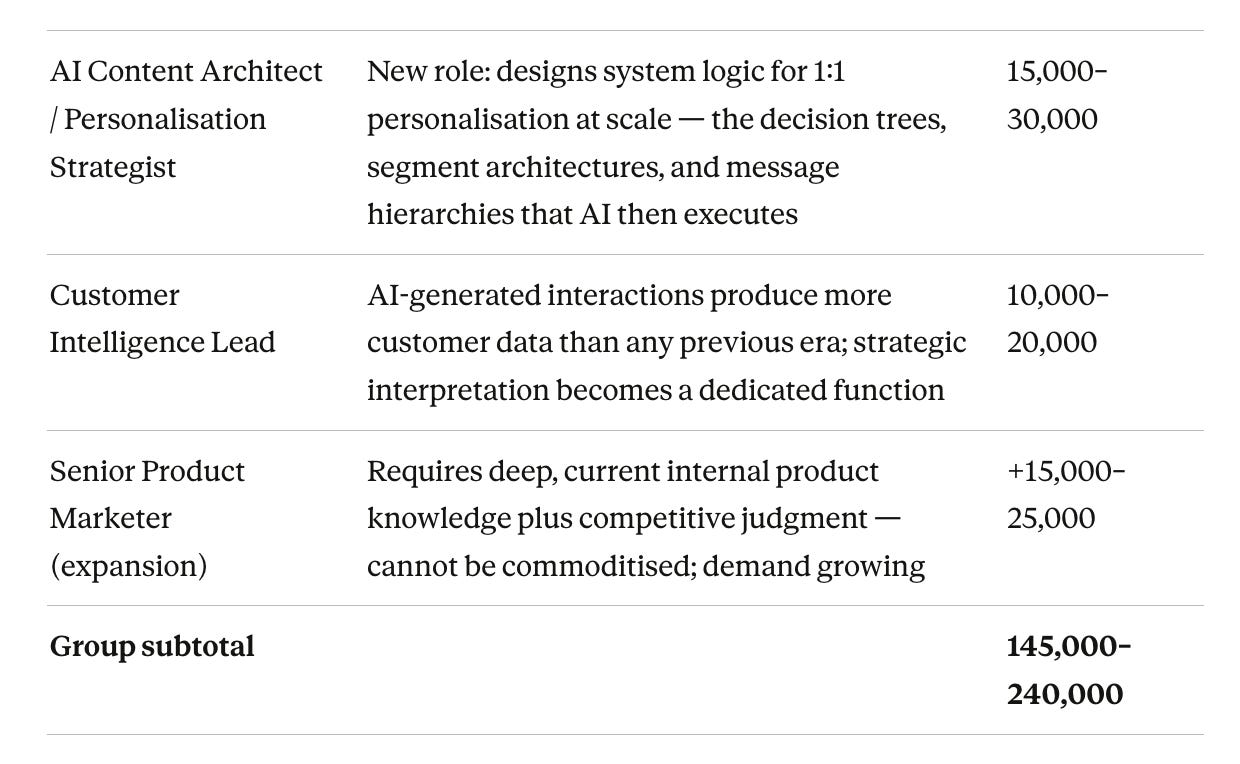
The bear case has numbers. The bull case deserves the same rigour. Here is the bottoms-up analysis of which specific roles expand, how fast, and what the net impact looks like across three scenarios.
The Net Impact: Three Scenarios
The bear and bull cases are not simply additive — they represent different futures depending on which causal chains hold. Here is what the net employment picture looks like across three scenarios over a five-to-seven year horizon.
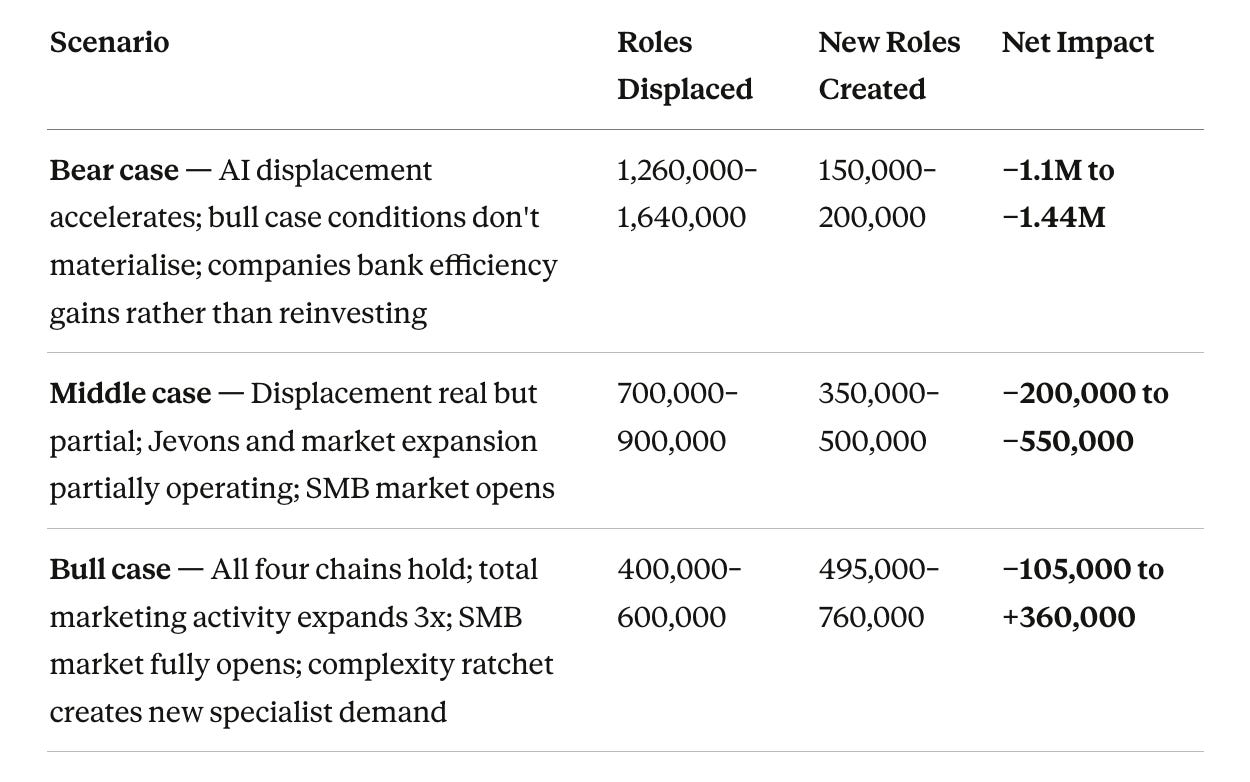
The “roughly flat” outcome is only achievable if the full bull case materialises — all four causal chains operating simultaneously, SMB demand expanding rapidly, and displaced workers successfully retraining into new specialist roles. That is possible. It is not the default.
The middle case — which requires only the Jevons effect and market expansion to partially operate, without needing the full complexity ratchet — still produces a net loss of 200,000 to 550,000 US marketing roles. That is not catastrophic for a 2.75-million-person profession, but it is not neutral either. It is the kind of loss that hollows out the junior and mid-career layers while leaving the senior and strategic layer intact — which is precisely the distribution problem that makes this transition harder than the aggregate number suggests.
I do think the new jobs may pay significantly more — the 56% AI skills wage premium and emerging roles like AI Creative Director ($150K+), Revenue Operations Lead ($110K+), and Marketing Data Scientist ($156K+) suggest the profession is repricing upward at the top while compressing at the base. But only if companies can realise the productivity gains at the output level (which means: these people are going to feel the strain of lifting output per person, similar to how generations above felt the strain of lifting to the pace of the Internet).
The Five Things to Watch
The bear and bull cases are not mutually exclusive. Both are operating. The question is which dominates over a five-to-seven year horizon. These are the leading indicators that will tell you, in real time, which case is winning.
1. The IPA Under-25 Employment Figure (annual). The collapse of the under-25 creative agency workforce is the single most important signal in this analysis. It is not a lagging indicator of displacement — it is a leading indicator of pipeline collapse. If senior creative talent is not being regenerated from below, the bull case’s supply of future strategists and directors starts to hollow out. Watch whether this number stabilises or continues declining.
2. Agency Revenue Per Head. If agencies are using AI to do more with fewer people and revenue per head is rising, the Jevons effect is operating — margin is expanding. If revenue per head is flat while headcount falls, it is pure displacement with the savings flowing to clients or shareholders. This is the simplest diagnostic for whether the efficiency gains are being reinvested in the profession or extracted from it.
3. CMO Budget Allocation Between Headcount and Technology. Gartner tracks this annually. Marketing technology currently accounts for 22% of total marketing budgets. The critical question is whether that technology spend is cannibalising headcount or growing alongside it. The answer varies by company stage and sector — but the aggregate trend will indicate whether the profession’s economics are improving or deteriorating.
4. Boutique Agency Formation Rates. If the market expansion chain is operating, lower AI-enabled costs should be driving a wave of new boutique agency formation as experienced practitioners go independent with leaner models. This is currently anecdotal. It needs to be quantified. Agency formation data from 2025–2026 is the clearest test of whether the SMB market opportunity is being captured.
5. Who Is Filling the New Roles. The 56% wage premium for AI-fluent marketing professionals is the most bullish data point in this analysis. But the origin of those hires matters enormously. If the people filling AI creative director, marketing economist, and data strategy roles are former junior copywriters and campaign coordinators who retrained, the transition is working. If they are software engineers and data scientists moving laterally into marketing, the profession is being disrupted from outside rather than regenerating from within.
The Honest Forecast
I think net marketing employment in the United States will decline by approximately 300,000 to 700,000 roles over the next five to seven years — in the middle case, where the Jevons effect and market expansion operate but not the full complexity ratchet. If the full bull case materialises, the profession returns to rough equilibrium with maybe even more jobs, at higher pay. If the bear case dominates, losses approach 1.1 million. The wide range is not analytical imprecision — it reflects my genuine uncertainty about whether four specific causal conditions will hold. The aggregate decline, wherever it lands, will conceal a structural rupture. A smaller, more senior, more technically capable profession emerges on the other side of a transition that produces severe and concentrated damage at the junior and mid-career layers.
The transition period — which is already underway and will intensify through 2027–2028 — is the dangerous part. During the transition, displacement moves faster than creation. Junior roles are eliminated before the new roles that require seniority have been defined and filled. The pipeline that historically produced senior creative directors, senior media strategists, and senior communications leads — built on years of doing the production work that AI is now replacing — breaks before anyone has designed an alternative pathway.
For individuals: the risk is not being replaced by AI. The risk is being replaced by a marketer who uses AI and can consequently operate at a level of strategic and analytical sophistication that previously required three to four people. That person exists. They are being hired now. The 56% wage premium for AI-fluent marketing professionals is not a temporary anomaly — it is a permanent repricing of what the profession values. The gap will widen before it narrows.
For companies: the risk is neither cutting too fast nor too slowly. It is failing to use the efficiency gains to raise the quality of strategic thinking rather than simply reducing the cost of execution. Every marketing organisation that banks the AI dividend as margin rather than reinvesting it in better strategy is making a competitive bet that its peers won’t do the same. In a market where AI makes execution nearly free, the only sustainable advantage is quality of judgment. You don’t build that by eliminating the people who develop it.
The marketing profession is not in decline. It is in compression — followed, if the causal conditions hold, by expansion at a higher level of productivity and strategic thinking. The question every marketer, every CMO, and every agency leader needs to answer is not whether this is happening. It clearly is. The question is whether you are positioning yourself on the right side of the bifurcation before the gap becomes uncrossable.
Bunch of sources I used for this, some good, some shit: BLS Occupational Employment and Wage Statistics · BLS Data Scientists Outlook · Autodesk 2025 AI Jobs Report · AI Job Trends 2025 · QuotaPath RevOps Market Analysis · Chief Marketing Technologist — DigitalDefynd · Robert Half Marketing Salary Trends 2026 · SMB Marketing Budget Statistics · CMO Survey: Marketing Budget Rebound · LinkedIn Future of Work Report: AI at Work · Jevons Paradox and DeepSeek — NPR · · Anthropic Labour Market Impacts Study, March 2026 · IPA Agency Census 2025 · Gartner CMO Spend Survey 2025 · Forrester Agency Workforce Predictions 2026 · State of PPC Report 2026 · Content Marketing Institute B2B Research 2024 · Goldman Sachs AI Employment Analysis 2023 · WEF Future of Jobs Report 2025 · PwC Global AI Jobs Barometer 2025 · Amazon DSP Performance+ · Meta Advantage+ — Nasdaq · Mondelēz/Respeecher Case Study · VideoWeek — Sorrell on Media Headcount · WPP Job Cuts — The Media Leader · Omnicom 2024 Cuts — PRWeek · Omnicom/IPG Merger Cuts — Axios · Dentsu Cuts — Japan Times · Klarna AI Workforce — CNBC · SEO Job Decline — Search Engine Journal · Blood in the Machine · DV360 CPM Deprecation — PPC Land · eMarketer — Marketing Specialists AI Exposure · CMO Survey — Headcount Intentions
Wonderful to see sober analysis when there is so much noice. Thanks for this Hen, incredibly valuable and insightful.
Uncomfortable, optimistic, thought provoking. Thanks.